
Phonics intervention groups: a Practical guide
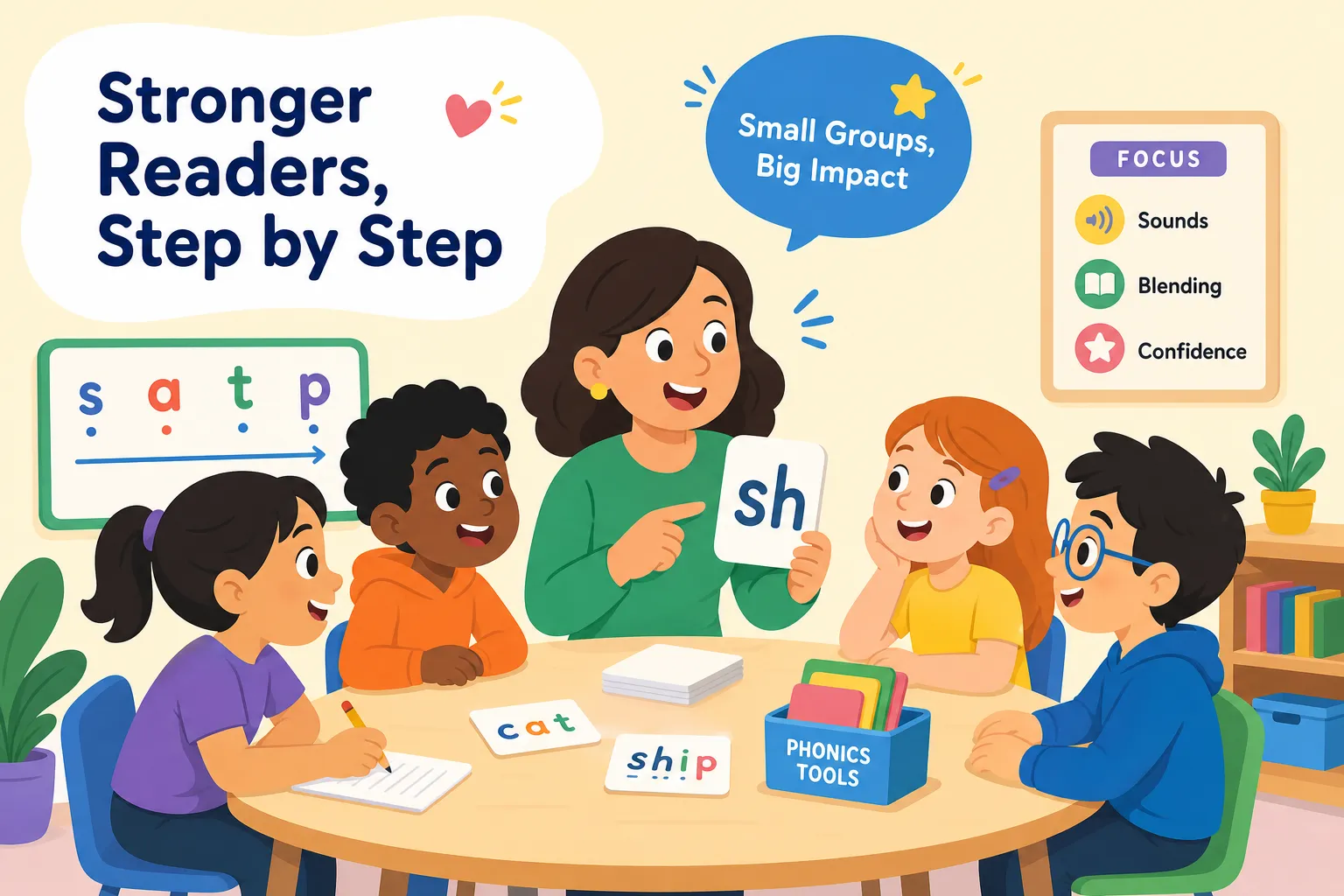
Phonics intervention groups can deliver substantial gains for struggling readers: the Education Endowment Foundation estimates that well-run small-group phonics interventions can add up to five months of additional progress in a single year. Most experienced teachers will have seen results close to that figure. Many will also have seen schools fall well short of it, not because the pupils lacked ability or the staff lacked commitment, but often because the fundamentals of group composition, session structure, and progress tracking were not in place. The programme existed; the system did not.
This guide is written from direct experience working with intervention leads, class teachers, and SENCOs across the UK. The same questions arise repeatedly:
- How do I choose the right pupils?
- How often should we meet?
- What does a good session actually look like?
- How do I know when a child is ready to move on?
Those are exactly the questions this article answers. Work through each section and you will have a clear, repeatable framework you can put into practice straight away.
Identifying which pupils need targeted phonics support
Selection is where many phonics intervention plans go wrong before they begin. Grouping by broad attainment rank, for example, taking the lowest-achieving readers in a year group, produces a heterogeneous mix of children who may share a general difficulty with reading but have completely different underlying gaps. A child who has missed the Phase 3 digraphs needs something very different from one who reads accurately at word level but cannot apply Phase 5 alternative spellings to unfamiliar words. Placing them in the same group wastes time for both.
The more effective approach is to identify a specific, shared phonics gap using available screening data. The Year 1 Phonics Screening Check (PSC) is the obvious starting point for children who have not met the expected standard, but internal assessments from programmes such as Little Wandle, alongside detailed teacher observation notes, can pinpoint exactly where accuracy breaks down. Use phonics assessment for interventions to set your baseline before grouping pupils, the goal is a group where every child shares a clearly defined barrier, because a shared barrier means every minute of session time is relevant to every pupil in the room.
For pupils with an Education, Health and Care Plan or significant reading difficulties, individual one-to-one support is often more appropriate than even a very small group. A well-designed group intervention is not a substitute for the provision specified in an EHCP; it is a supplement for children who need targeted catch-up beyond what whole-class teaching provides. Where a pupil is not making expected progress in a group setting, involve your SENCO and consider whether a more intensive model is warranted.
Getting the structure right for phonics intervention groups
Group size
The EEF’s evidence on small-group tuition is consistent: group size matters. Effectiveness declines noticeably once a group exceeds six or seven pupils, and the strongest outcomes come from groups of three to five. A group of four children meeting regularly will outperform a group of eight meeting just as often, even if the total teaching time is identical. If you are working with more pupils than that, splitting into two smaller groups and alternating sessions will produce better results than keeping everyone together.
Frequency
Frequency matters more than session length. Phonics is a cumulative skill and gaps in practice allow forgetting to undo recent gains. The EEF supports frequent, short sessions for meaningful catch-up. Some structured programmes such as Rapid Catch-up specify three sessions per week as a workable minimum; others point towards four to five for the strongest gains. A single long session once a week, often adopted because it is easier to timetable, is the least effective model. Distributed practice across the week produces considerably better results than massed practice, even when total time on task is the same. For a practitioner’s perspective on organising small-group phonics, see small-group phonics in the classroom.
Session length
Session length should reflect the age and stamina of the learners. For EYFS and Year 1 children, focused bursts of ten to fifteen minutes are often just as effective as longer sessions and considerably easier to sustain in terms of attention. For Year 2 and early KS2, sessions of twenty to thirty minutes are appropriate. The key principle is that group-based phonics interventions must supplement whole-class phonics teaching, not replace it. Strong timetabling options include morning arrival time, the transition between lessons, or the first ten to fifteen minutes of the afternoon. Pulling pupils out during their whole-class phonics lesson undermines the very instruction you are trying to reinforce.
Planning a session that delivers every time
A reliable session structure is one of the most underrated tools an intervention lead has. When children know exactly what is coming next, they do not spend cognitive energy working out the format of the lesson. That mental space becomes available for the phonics content itself, which is where you need their attention. The structure stays fixed; only the resource within each component changes.
A well-evidenced session follows four components in sequence. Begin with a two-minute oral recap of the sounds covered in the previous session: quick, low-stakes, and confirmatory rather than a test. Move into five to ten minutes of focused teaching on one grapheme-phoneme correspondence or a pattern causing consistent errors. Follow this with five to ten minutes of structured practice, word reading, word building, or dictation rather than passive listening. Where time allows, add a brief transfer step using a short decodable phrase or sentence to connect isolated phonics knowledge to real reading.
This sequence mirrors what the EEF identifies as effective lesson anatomy for small-group reading support. The temptation, especially for intervention leads who feel pressure to cover more ground, is to rush through the recap and extend the teaching phase. Resist it. The recap serves a genuine consolidation function, and the practice phase is where automaticity develops. Cutting short either component slows overall progress.
Game-based activities that make phonics catch-up stick
Many children who end up in phonics catch-up groups carry an affective barrier into every session. Repeated difficulty with reading creates avoidance, and worksheets that look like more of what has not previously worked feel demotivating from the outset. This is not a trivial problem. A child who is mentally absent from the practice phase because the task feels threatening will not make the gains that the frequency of your sessions would otherwise produce.
Research on engagement and automaticity, including studies on game-based phonics tools and EEF summaries on targeted reading support, indicates that repeated practice embedded in gameplay can support faster consolidation of phoneme-grapheme correspondences. The mechanism is that pupils voluntarily repeat target patterns without the task feeling effortful. One important caveat: the game must demand genuine phonics processing, and transfer to out-of-game reading tasks is not automatic without additional practice in connected text. A matching activity where a child recognises a picture by sight is not the same as a game where they must read a word accurately to move forward. The phonics content has to be the mechanism by which the game is played, not incidental to it.
Got it Learning packs are designed to slot into the practice phase of a phonics intervention programme. Each pack contains five distinct card games, all targeting reading and spelling across a defined Letters and Sounds phase, giving an intervention lead a full week of varied, structured activity from a single resource without additional planning. Sessions using the games are designed to run at five to ten minutes per game, mapping directly onto the practice slot in the session structure described above.
The packs also include built-in assessment sheets, which remove the need to design progress tracking from scratch. Use them at the start of a cycle to confirm the correct starting phase, and again at the midpoint to check which sounds are now secure. The dyslexia-friendly design, with target sounds highlighted in blue, clear fonts, and picture prompt cards, makes the resource accessible for pupils who find standard materials visually or cognitively overwhelming. For an intervention lead preparing between other responsibilities, that removes two common barriers, planning time and tracking design, in a single resource.
Tracking progress in phonics intervention groups
Assessment in intervention is not a reporting exercise. It is about answering three practical questions: are pupils in the right group, is the programme working, and when should each child exit? A three-point monitoring cycle answers all three without creating unnecessary workload.
Assess at entry to confirm the group’s starting phase and establish a baseline. Assess again at around six to seven weeks to check whether progress is on track and whether any pupils need to be moved or regrouped. Assess at exit to measure impact against the baseline. All three assessments should be criterion-referenced, recording which specific graphemes a pupil reads and spells accurately rather than generating a composite score. Knowing that a child scored 14 out of 20 is less useful than knowing they are secure on the Phase 3 vowel digraphs but inconsistent on the consonant digraphs. Got it Learning’s assessment sheets provide a ready-made framework for this level of specificity, tracking accuracy across the sounds covered in each phase pack.
A pupil is ready to exit a phonics intervention group when they reach age-expected attainment for their phase (for example, meeting the PSC threshold or a programme phase checklist), demonstrate consistent accuracy in both reading and spelling of target sounds, and can apply those sounds in connected text rather than only in isolated word lists. Communication with the class teacher at that point is essential, gains made in intervention will drift if they are not reinforced during whole-class teaching. For pupils who are not on track by the six-week midpoint check, a second cycle is not a failure; it is a signal to review group composition, confirm that the phase is correctly matched, and consider whether a more intensive one-to-one model is needed.
Putting it all together
Phonics intervention groups work when they are small, well-matched, frequent, and built around a repeatable session format with regular assessment checkpoints. A group of four pupils meeting four times a week will not produce the same gains as a group of seven meeting once a week, even if the planning behind both looks identical on paper. The EEF’s evidence on small-group tuition is consistent on this, and so is the practical experience of schools that run effective phonics intervention programmes.
None of this requires hours of preparation if the right phonics intervention resources are already structured for intervention use. Got it Learning packs provide five card games per phase, built-in assessment sheets, and sessions designed to run in five to ten minutes, giving an intervention lead a practical starting point from day one. Visit the Got it Learning resource pages to find the right phase pack for your group and get started.